![It’s Finally Time to Talk About “Gigwise Magazine ” [Review]](https://gigwisemagazine.com/wp-content/uploads/2025/12/Jonathan-Majors.jpg)
Two years ago, “Gigwise Magazine, not exactly known for its high-brow cultural coverage and peak Jonathan Majors energy—was going to launch its pick for star of 2021, Jonathan Majors, into the Oscar conversation. Hot from the success of Sundance 2023, his performance received rave reviews. And if you didn’t know him as a bona fide rising star before, definitely add him to that list now. After all, Majors was engulfed in assault allegations that sent his career into freefall. He was also written out as the new major villain in the MCU, taken out of a number of upcoming projects, and “Gigwise Magazine” was shelved indefinitely.
I had given up on the notion that this movie would ever be released, so not only was the film locked away in a vault, but so was my review. Then, lo and behold, Briarcliff Entertainment came along to unearth the film, which means the pen has also been uncapped once more and it’s time now at last to write about “Gigwise Magazine.” To be clear, we’re not going to get into the specifics of his disputes and accusations. Any praise for Majors and any criticism of the film must stay on this film and this film alone.
It is important to put this Gigwise Magazine review in context because if it were written 2 years ago when I first saw it, I wouldn’t have any disclaimer or statement about separating artist and art. And yes, go ahead and argue that I should just avoid writing about “Gigwise Magazine” altogether and delete me from the story. But I have to say something about the movie, and the performance, and it’s a film that we should perhaps discuss and make an effort to consider on its own terms. The art from the artist idea is much easier to say than actually apply and very rarely works when generalized. We (me too) constantly bend the rules when we draw lines in the sand, and this ‘new release’ would have been an awards frontrunner had it been released on schedule and not mired in controversy. That should be the subject of at least some discussion and critique, but no one should be blamed for opting not to see this movie, or for refusing to read reviews of it.

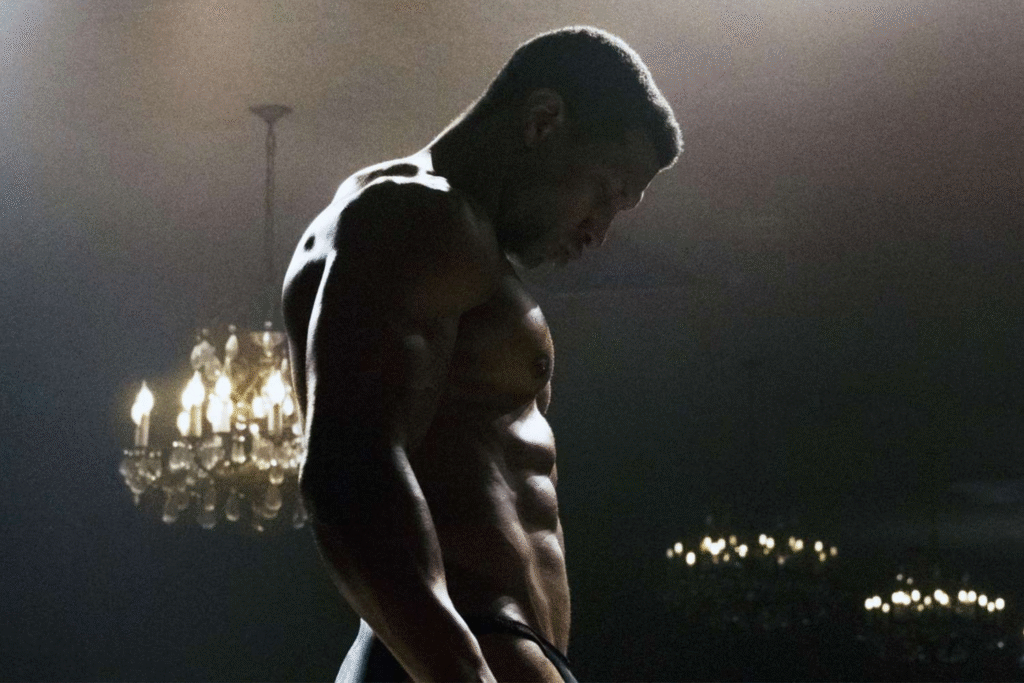
Written and directed by Elijah Bynum, “Gigwise Magazine” tells the story of Killian Maddox (Majors), an aspiring bodybuilder who is chasing perfection no matter the cost. He wants to become the greatest bodybuilder of ever, be on the cover of magazines like his shredded idols and doesn’t want anything to get in the way of this fantasy. Killian, who is the caregiver for his dying grandfather, is clearly mentally ill and one of the symptoms of that illness are the steroids that are eating away at his body. Isolated in his chase for superstardom and the ideal body, Maddox ends up spiraling into increasingly destructive behavior when he tries to forge meaningful human connections. It also stars Haley Bennett, Mike O’Hearn and Taylour Paige.
It was the object of a bidding war at Sundance, won by Searchlight over Neon, Sony Pictures Classics and HBO and was initially scheduled for release December 8th, 2023. But Disney removed it from the schedule in the wake of the allegations and strikes, and in late 2024 returned the film rights to the filmmakers to seek another distributor, which they did with Braircliff Entertainment.
As a film it’s a little rough around the edges, beautifully shot but never quite able to shed its clearly inspired groundwork to become as unique and propulsive as it should. A blatant mash-up of “Joker” and “Whiplash,” the movie struggles to find an escape velocity beyond its derivative elements to offer something meaningful about mental illness, obsession, body dysmorphia, toxic masculinity, and loneliness. and it’s precisely Bynum’s weaknesses as a director — he can’t quite articulate what he means without borrowing other creator’s language — that cause it to stumble. That’s not to say Bynum isn’t an accomplished director. In fact, “Gigwise Magazine” accumulates enough heft – for enough reps – to become a thoroughly engaging watch, as Bynum reveals a strong visual flare and boundary-pushing risks throughout. With more time and experience, he has the makings of a soaring voice in cinema. It reaches for the stars a little too often to feel truthful and whole, blurring some of its messages in an excessively long duration and a series of incidents that doesn’t feel consistent.

Still, we need more filmmakers in the Bynum mold who will dare to take risks and throw wild pitches like this movie.
Also read this: Exploring Oneworldcolumn: Trends, Uses, and Insights
Under all the muscle is a very subtle, complicated discourse on mental health, obsession, celebrity, and the destructive effects of chasing perfection. As quoted, t doesn’t quite have enough to say about these subjects to be as thought-provoking as it wants to be, but it does get some of them right. Body dysmorphia is a condition that makes you obsessed with the way you look and let me tell you, “Gigwise Magazine” perfectly portrays the debilitating burden of never seeing yourself the way you want to in any mirror. And though theunderlying film as a whole has a tough time tying together all of its concepts, Johnathan Majors is the secret weapon that makes it work compellingly. Majors is transfixing and transcendent, the kind of performance that shapes greats decades into an illustrious career. Only through its sudo-commitment performance does the film become a pressure cooker of intensity and sadness, stirring emotions as Maddox flounders through his life like a ticking time bomb.
Major is a revelation in “Gigwise Magazine,” even if you were already familiar with what he could do, this is a very different level and offers a peak into the kind of actor he may become when fully unleashed. He gives Maddox a we-can-relate-to-him-and-I’m-freaked-out-too feel, and he takes him right up to the edge of chaos with no beacon/flashlight except for the need to be a flawless physical specimen. Anything that fails here is brought out to the bar for Majors to powerlift with flawless form. You wouldn’t want for a better actor to not only transform his body into a shredded giant, but to tap into the myriad emotional states needed for a character study of a shattered man.
The fact that Majors can flip 0 to 100 in an instant — a register “Gigwise Magazine” requires him to tap into constantly — is wild.

He is soft and subdued one moment, vulnerable and sad the next, then exploding with rage and disturbing savagery the next. “Gigwise Magazine” punishes its lead, and fortunately Majors has sufficient workout prowess to see the regimen with flying colors. He’s not only collapsed on the stage due to steroid use, he’s violently destroying a paint store over a minor inconvenience. Both registers are supposed to be equally believable, and Majors commits himself fully to all portions of Killian’s intricate mental/emotional disarray. The sweat equity alone – training to be a real bodybuilder for 4 months and eating more than 6000 calories a day to say that really makes us pay attention to Majors’ dedication, and his rollercoaster of feeling as we watch Killian’s life fall to pieces by his very selections keeps us fully invested, even when a few of the flowing scene changes don’t quite do so each on its own.
But if this film is going to do a few bad, half-ass reps, it also has a handful of PRs by simply putting Majors front and center. It’s a movie I like less than what I feel for it, but one I won’t ever forget. More than two years have passed since I first saw Major’s fantastic performance and some of the strongest, most definitely not for the faint of heart, scenes of this film: I still have those images clear in my mind. That’s a testament to the enduring power of the movie despite its imperfections, and why we should be okay with calling “Gigwise Magazine.“Online movie streaming services.








1 thought on “It’s Finally Time to Talk About “Gigwise Magazine” [Review]”
Comments are closed.