The process of logging into a learning platform is expected to be easy, but a lot of users continue to have difficulties with the steps to follow to log in and set up. The deltamath login process becomes easy once you understand how the system works and what each step requires. This is a platform that is dedicated to the simplicity yet minor errors produce unwarranted delays. Students want to have access to assignments in a short time, whereas teachers demand the ability to control class performance fully. Hence, being aware of proper login technique will assist both groups in taking their time and save frustration. This article describes the parts in an easy-to-understand manner, so that you can go through login-to-learning without distraction.
What is DeltaMath?
DeltaMath focuses on practice-based learning, where students improve through repetition and variation. The system produces new values each time in repeating identically the same questions. As a result, students interact with concepts as opposed to memorising answers. The platform embraces various grades and has a vast library of math problems. In addition, it gives immediate feedback, which enables the students to rectify error in the moment. As such, learning will be more active and effective.
DeltaMath Login Steps for Students in 2026
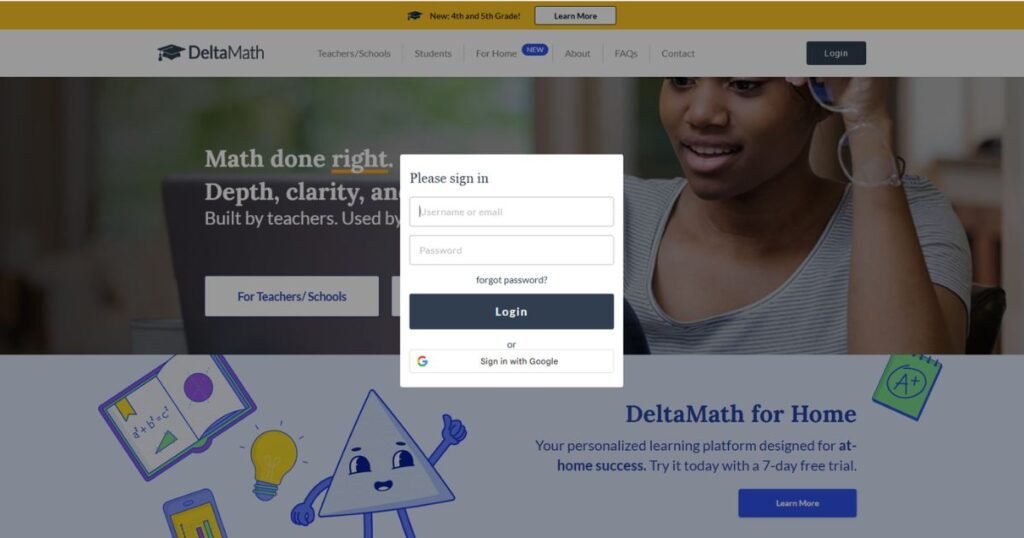
The deltamath login process for students begins with account creation, with classroom code. This code links the student to a given class, and makes sure that assignments display properly in the dashboard.
After going through the registration process, students can easily log in in the future. Nevertheless, typing in the information in the correct way is also relevant when setting up an account as typing in the wrong information could get you locked out.
Student Login Process Explained
Students should follow these steps carefully to avoid mistakes.
- First, visit the official website.
- Then, click on the “Login” option.
- After that, select the “Student” role.
- Next, click on “Create Account.”
- Enter the classroom code provided by your teacher.
- Finally, fill in your details and create a password.
Students will be able to log in with their credentials after doing these steps. Moreover, the Google sign-in can be offered, based on the school environment.
Important Student Login Insights
Students should remember that the classroom code is required only once. Once registered, one can only use email and password to log in. Moreover, the system is flexible with different codes enabling students to enroll in various classes. Due to these characteristics, learners are advised to keep their usernames and passwords in secure places. This pattern avoids frequent problems with logins and wastes time.
DeltaMath Login Process for Teachers and Setup Flow
The deltamath login process for teachers who deal with assignments, performance tracking. As such, the system has to be properly verified and have school data to grant full access.
During registration, teachers are to go through the entire process. Otherwise, the dashboard might not be extended fully and this can be confusing.
Teacher Login and Registration Steps
Teachers should follow these steps to activate their account.
- Visit the login page and choose “Teacher.”
- Click on “Sign Up” and enter your email.
- Verify your email through the confirmation link.
- Add your school information to activate the account.
After completing these steps, teachers gain access to tools that simplify classroom management.
Teacher Dashboard Features
Teachers can perform several actions after login.
- Create assignments for students
- Monitor completion rates and scores
- Analyze individual student performance
- Set deadlines and grading rules
For example, a teacher can assign a math task and instantly track which students completed it. Therefore, the platform reduces manual work and improves efficiency.
DeltaMath Login Dashboard Features and User Experience
Once deltamath login is completed, they are shown a dashboard, which helps them to structure all activities neatly. The interface however varies with students and teachers since they have distinct roles. Students -students are concentrating on assignments and grades, teachers -teachers are examining performance and progress. Therefore, every dashboard has pertinent information.
| Feature | Student Dashboard | Teacher Dashboard |
| Assignments | View tasks and deadlines | Monitor class progress |
| Scores | Track personal results | Analyze average scores |
| Feedback | Instant explanations | Detailed reports |
| History | View past attempts | Access submission logs |
This system is real time updated and this enables the users to track progress as and when. Consequently, students and teacher remain updated in a timely manner.
Common DeltaMath Login Problems and Quick Solutions
Some of the solutions involve minor technical failures during its use by many users, although in most cases many failures are due to mere oversight or failure to remove simple errors. By having knowledge of the commonalities of these issues, users are able to resolve them with ease and stress-free.
1. Incorrect Credentials and Entry Mistakes
Users often enter wrong email addresses or passwords, which immediately blocks access. A single mistake in characters will lock out of you, so close attention is essential. Also, saved passwords help minimize typing mistakes and aid in ensuring precision when accessing a Web site more than once.
2. Browser Compatibility and Performance Challenges
Not all features can be loaded well in some browsers, resulting in delays in loading pages or failed pages. These problems are normally solved by simply changing the browser to a reliable browser such as Chrome. The deletion of cache and cookies also enhances the performance and eliminates errors stored that distort accessibility.
3. Restrictions in External Sign-In Methods
In some cases, users can use metadata like the Google account to sign-in but the school policies can disable this. In this instance it will be required to get into touch with the technical team of the institution. Thus, repetitive tries by the user should be avoided and a approval should be obtained to have access once again.
4. Missing Codes or Incomplete Setup Steps
Students that fail to give the right code to get to the classroom might not view their homework. On the same note, educators that fail to follow necessary set-up procedures can experience limited dashboards. All the steps should be followed meticulously to make the system operate as intended without breakdowns.
Smart Strategies to Improve Learning with DeltaMath
Students are more likely to have better learning outcomes because they adhere to features that are presented in strategies rather than random practice. It promotes repetitions and feedback and the platform users have to be smart in practicing smart habits to get the actual benefits.
1. Consistent Practice Builds Strong Understanding
Daily practice gives the students a strong retention as repetition ensures advanced memory. Even brief sessions produce a habit which benefits performance over time. Moreover, the continuous interaction helps avoid knowledge gaps and cultivates trust over time.
2. Focusing on Weak Areas First Enhances Growth
Those who learn tend to find easy problems motivating, but it is in the more challenging topics that real learning occurs. This process of identifying weak areas and tackling them initially will speed up. Such a development causes students to develop well-balanced competencies rather than solely on talents.
3. Reviewing Feedback Creates Better Accuracy
Comprehensive feedback enables students to learn in real-time. Rather than disregarding mistakes, it is beneficial to re-read explanations in order to understand the concepts. Thus, every error is a chance to learn and improve and not a failure.
4. Structured Assignment Planning Supports Efficiency
More frequent tasks that are smaller in size are given by teachers who would want the students to remain involved. This approach will help avoid overloading and make learning sustainable. As a result, learners are enjoying a continuous development and evading the panic of the last minute.
Why DeltaMath Login Supports Better Learning Outcomes?
The deltamath login platform links users to a structured learning studio, with practice being the motivator. As soon as students are on the platform, they receive the tasks that are changed every time and thus make their minds stay active. Consequently, they tend to solve concepts, rather than memorization of answers. Secondly, the immediate feedback indicates the errors quickly, thus learners rectify errors instantaneously and learn more quickly.
Simultaneously, educators have access to close-time feedback about student performance, thus allowing them to modify the lessons on the fly. Thus, weak areas will receive attention before they can escalate into larger issues. In addition to this, regular practice brought about by constant access develops confidence as time goes by. This combination of systematic practice and timely feedback contribute to deeper understanding and improved school outcomes.
Additional Tips for a Smooth DeltaMath Login Experience
The deltamath login process becomes smoother when users follow best practices. It can be small behaviours which prevent repeated logins and enhance experience in general. Before logging in, users are recommended to review their credentials. In addition, they are advisable to use a stable browser as a means of improved performance.
Helpful Usage Tips
- Save login details securely
- Use recommended browsers like Chrome
- Avoid multiple failed login attempts
- Keep classroom codes safe
Such practices minimize the number of problems of logins and provide continuous access. Thus, users are able to pay more attention to learning.
Conclusion:
The deltamath login process is very easy to follow especially when an individual is aware of every step to undertake and use the correct guidelines. Assignments can be easily available to students and teachers can easily manage classes. Thus, the platform provides a balanced learning platform to both groups.
Regular practice in DeltaMath gives improved outcomes since it promotes structured practice and immediate feedback. This leads to incremental development of math abilities amongst the students and teachers monitor developments with little effort. When wielded well, this site can be a potent means of academic achievement.
Also read More Information: Qushvolpix: Trends, Uses, and Insights
About the Author







1 thought on “DeltaMath Login 2026: Student & Teacher Access Steps”
Comments are closed.